

The Bell 206 Long Ranger is a single-engine helicopter with a stretched cabin, and it has spent decades doing the hardest everyday work in mountain country. It carries up to five passengers, its seats come out for cargo, and it holds its power at altitude. That mix is why it’s a standard machine for scenic flights, backcountry drop-offs, and utility work in places with no road and no runway.
Choice Aviation flies a Bell 206 Long Ranger out of Hamilton, Montana, in the Bitterroot Valley. This guide explains what the aircraft is good at, what it isn’t, the jobs it gets hired for, how mountain conditions change what it can carry, and how to plan a trip in one.
At a glance:
- What it is: a single-engine light helicopter with a stretched cabin, built for utility and passenger work.
- Passengers: up to 5 in Choice’s Long Ranger.
- Cargo: removable seating, so the cabin carries gear, game, camp kit, or equipment.
- Landing spot: roughly the size of a tennis court.
- Mountain performance: good power at altitude, though density altitude still limits the load on hot days.
- Where Choice flies it: based at Hamilton (HRF), working across western Montana.
- Jobs: scenic flights, VIP and weddings, backcountry access, long-line and survey, film, and remote-site transport.
Table of Contents
What Is the Bell 206 Long Ranger?
The Bell 206 Long Ranger is the long-cabin member of Bell’s 206 helicopter family. Bell stretched the cabin of the smaller 206 so it could carry more people or more cargo in the same light, single-engine package. The result is a helicopter that works as a five-passenger air taxi one day and a cargo or utility machine the next.
That flexibility is the reason the Long Ranger shows up in so many mountain operations. One aircraft can fly a sightseeing couple in the morning, a hunting party’s gear in the afternoon, and a survey crew the next day. Operators in remote country can’t afford a separate aircraft for each job, so they pick one that does all of them well.
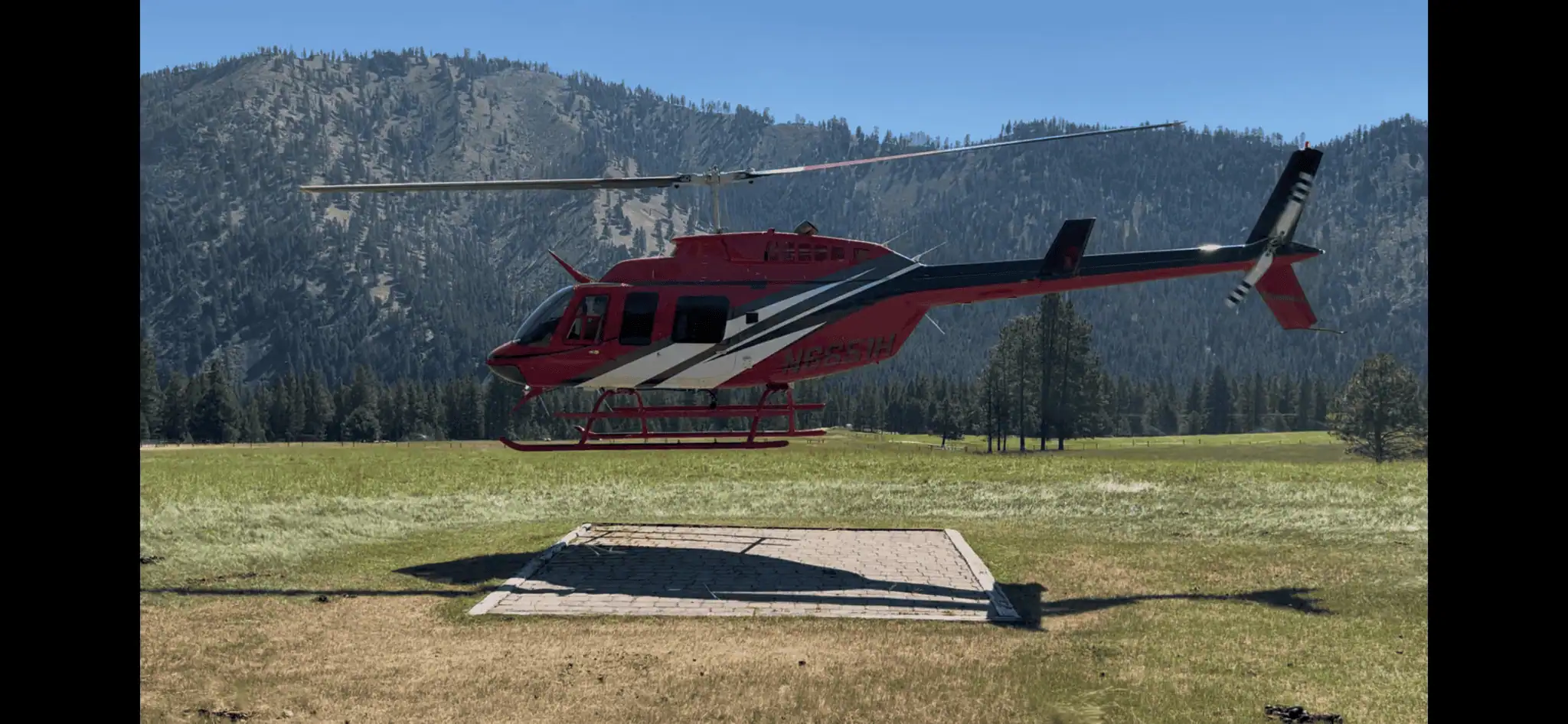
Choice’s helicopter is a Bell 206 Long Ranger based at Hamilton.

Why the Bell 206 Long Ranger Works So Well in the Mountains
The Long Ranger earns its reputation in the mountains because of three traits: cabin room, power at altitude, and the ability to land almost anywhere flat enough.
A cabin that does two jobs
The stretched cabin seats up to five passengers. The seats come out, and with the cabin set up for cargo, the Long Ranger carries gear instead of people. For a backcountry job, that’s often what’s needed: tents, coolers, survey equipment, or a hunting party’s camp.
Power at altitude
Mountain airports and landing areas sit high, and high elevation means thin air. A helicopter that’s comfortable at sea level can run short of power at 7,000 feet. The Long Ranger has good power at altitude for its class, which is why it’s a common choice for operators who live in the high country.
A small landing footprint
An airplane needs a runway, or at least a long, flat strip. A helicopter needs a spot about the size of a tennis court. That changes what counts as a destination: a ridgeline, a meadow, a gravel bar, or the lawn behind a venue, where landing is permitted.
It can hover
A helicopter can hold still in the air. That lets a photographer work a single spot, a load go down on a line to an exact point, or the pilot come in slow and low to look over a landing area before committing to it.
What Choice Flies the Bell 206 Long Ranger For
Choice hires out its Long Ranger for six main kinds of work. Each one uses the aircraft a little differently.
Scenic flights
Scenic flights from Hamilton cover the Selway–Bitterroot Wilderness, the Bitterroot Mountains and Trapper Peak, and the Sapphire Mountains on the east side of the valley. Terrain that looks like one wall of mountains from the valley floor turns into separate ridges and basins from the air. Flights over designated Wilderness are overflights. See the Selway Bitterroot Wilderness guide for the route and the rules.
VIP, weddings, and proposals
The Long Ranger flies VIP transport, wedding arrivals and departures, proposals, sunset flights, and graduation and anniversary trips. A helicopter can land at a venue where an airplane never could, as long as the landing spot is suitable and permitted.
Backcountry access
For hunting, fishing, and camping parties, the Long Ranger does drop-offs and pickups at permitted landing areas well beyond the trailheads. Landings inside designated Wilderness and parts of national parks are restricted, so drop-offs go to permitted areas outside them. See backcountry charters for how those trips are planned.
Long-line, survey, and utility
Choice flies external-load work, aerial survey, and contract utility flights into sites with no road access. External loads hang below the helicopter on a line, so the aircraft can set equipment in places it couldn’t land. More on the rules for that work below.
Film and photography
For aerial video and stills, the Long Ranger flies to a brief: hovering, tracking a subject, and making repeat passes on the same line until the shot works.
Corporate and remote sites
The Long Ranger moves people to mining sites, ranches, energy infrastructure, and other places a fixed-wing can’t reach. For a crew that would otherwise spend hours on a rough road, the helicopter turns a day trip into an hour.
Bell 206 Long Ranger Performance: How Mountains Change the Numbers
Every helicopter’s performance changes with altitude, temperature, and weight. In the mountains, those changes matter more than anywhere else. The FAA’s Helicopter Flying Handbook covers the physics in detail. Here’s what it means for a Long Ranger flight.
Density altitude. Air gets thinner as elevation rises and as the temperature climbs. Thin air means the rotor produces less lift and the engine produces less power. A hot afternoon at a high landing area can feel, to the helicopter, like a much higher elevation than the map shows.
Weight. The heavier the load, the more power the helicopter needs to hover and climb. Because power drops as density altitude rises, a load that’s easy in the valley in the morning may be too much for a high landing area in the afternoon.
Hovering. Hovering close to the ground takes less power than hovering high above it, because the rotor gets help from its own downwash against the surface. Landing areas on ridges or with a drop-off nearby lose some of that help. Pilots plan for it.
What this means for you: your pilot will ask for real passenger and cargo weights, and may split a big load into two trips or move a flight to the cooler morning. That’s normal mountain flying, and it’s how the Long Ranger stays safe in high country.
Long-Line and External Load Work with the Bell 206 Long Ranger
External-load work is one of the jobs the Long Ranger is best known for. The load hangs below the aircraft on a line, so the helicopter can deliver it to a spot it can’t land on.
The FAA regulates this work under 14 CFR part 133. Two rules matter most to a customer:
- The operator needs a certificate. Under 14 CFR 133.11, no one may conduct rotorcraft external-load operations without a Rotorcraft External-Load Operator Certificate.
- The operator sets limits for each load. Under 14 CFR 133.45, the operator has to set weight, center of gravity, and other limits for each rotorcraft-load combination in a flight manual for that work.
In practice, that means the operator will ask exactly what you need moved: the weight of each piece, its size, how it can be rigged, and where it’s going. Odd shapes and light, bulky loads can behave badly on a line at speed, so the answers shape how the job is flown.
Safety: Flying a Bell 206 Long Ranger in Mountain Terrain
Rotor-wing work in Bitterroot terrain doesn’t forgive guesswork. The pilot matters more than the aircraft. Choice’s approach includes:
- Pilots with thousands of hours in this specific terrain.
- Conservative weather minimums. Choice will move your flight rather than push into mountain weather.
- Every landing area assessed before the skids touch down: size, slope, surface, and an escape route.
- Survival and communications equipment aboard every backcountry flight as standard.
Mountain pilots also watch the wind. Air flowing over a ridge tumbles down the far side and creates mechanical turbulence. A pilot who knows the terrain flies the smooth side of a ridge and picks approach paths to match the wind of the day.
Altitude rules
Helicopters have some flexibility under 14 CFR 91.119. The rule lets a helicopter fly below the fixed-wing minimum altitudes when it can do so without hazard to people or property on the surface. That’s what lets the Long Ranger approach a landing area or work a long-line job. Over wilderness, operators stay high, and scenic flights there are overflights.

Maintenance: Why an In-House Shop Matters
Choice maintains its Long Ranger in its own shop, on its own ramp. The work runs on Choice’s own schedule, and the technicians know this airframe’s history in detail.
For a customer, in-house maintenance means two things. Scheduling is simpler, because the shop and the flight department answer to the same company. And the people inspecting the helicopter know how it’s been flown, which is the history that matters in mountain work.
Bell 206 Long Ranger vs. a Fixed-Wing: Which Do You Need?
A helicopter is a different tool from an airplane, with different strengths. For a lot of trips, a fixed-wing is the better answer, and Choice will say so.
Pick the Bell 206 Long Ranger when:
- There’s no runway where you’re going.
- You need to land on a ridge, a meadow, a gravel bar, or a venue lawn (where permitted).
- The job needs a hover: photography, a long-line delivery, or a careful look before landing.
- The trip is short and the ground route is slow or doesn’t exist.
Pick a fixed-wing when:
- Both ends have a runway or a usable backcountry strip.
- The trip is long. Airplanes are faster and cost less per mile.
- You’re crossing a region or the country. Choice’s aircraft charter fleet covers regional and national trips.
Choice flies both, so there’s no reason to steer you to the wrong one. Tell them the destination and the load, and they’ll match the aircraft to the trip.
How Much Does a Bell 206 Long Ranger Charter Cost?
Helicopter charter is usually priced by flight time, and the total depends on the route, the load, and how long the aircraft is tied up on your job.
To get an accurate quote, have this ready:
- Where you’re starting and where you want to land.
- The date, with some flexibility for weather.
- How many people, and their weights.
- What you’re carrying, with weights and sizes.
- Whether the aircraft waits for you or comes back for a pickup.
How to Plan a Bell 206 Long Ranger Flight from Hamilton
Planning a Bell 206 Long Ranger trip is simple once you know what the operator needs.
- Start with the destination. Give Choice the place, even if it’s a point on a map. They’ll tell you whether it’s flyable and whether landing there is permitted.
- Share the load honestly. Real weights for people and gear let the pilot plan for density altitude.
- Build in weather flexibility. Mountain weather decides the schedule. Have a backup day if the date matters.
- Sort out permits. For hunting, fishing, or camping drop-offs, licenses and land-access permits are your responsibility. Choice will point you to the right agency.
- Confirm the plan. Choice will tell you what it takes and what it costs.
How many passengers does a Bell 206 Long Ranger carry?
Choice’s Bell 206 Long Ranger carries up to 5 passengers. The total also depends on passenger and baggage weight and on conditions that day, especially at high-elevation landing areas on warm days.
Can the Bell 206 Long Ranger carry cargo?
Yes. The seats are removable, and with the cabin configured for cargo, it carries gear, game, camp kit, or equipment. Loads can also be carried below the aircraft on a line for long-line work.
Is the Bell 206 Long Ranger a good helicopter for mountain flying?
Yes. It’s a standard machine for mountain work because of its stretched cabin, good power at altitude, and decades of use in backcountry operations. The pilot’s mountain experience matters as much as the aircraft.
Where can a Bell 206 Long Ranger land?
On any suitable spot roughly the size of a tennis court where landing is permitted. Landings are restricted inside designated Wilderness and parts of national parks, so flights there are overflights or land at permitted areas nearby.
How high can a Bell 206 Long Ranger fly in the mountains?
It’s high-altitude capable, but how much it can carry drops as elevation and temperature rise. Pilots plan loads around density altitude and may split heavy loads or fly in the cooler morning.
What happens if the weather is bad on my flight day?
Choice holds conservative weather minimums and will move your flight rather than push into mountain weather. Build a backup day into your plans if the date matters.
Who maintains Choice’s Bell 206 Long Ranger?
Choice’s own shop, on its own ramp in Hamilton. The technicians know this airframe’s history in detail.
Should I charter a helicopter or an airplane?
Use the helicopter when there’s no runway, when you need to hover, or for short trips into rough country. Use an airplane for longer trips between runways. Choice flies both and will recommend the right one.
Book the Bell 206 Long Ranger
The Bell 206 Long Ranger is a workhorse because it does many jobs well in the conditions mountain country throws at it: thin air, small landing spots, and no roads. Choice flies it out of Hamilton with pilots who know the Bitterroots and a shop that knows the aircraft.
Tell Choice where you want to land, the date, how many people, and what they’re carrying. They’ll tell you whether it’s flyable, what it takes, and what it costs.

